
Case study · Built by Lightly Coded
Page one for the head term, and a signed client, in five weeks.
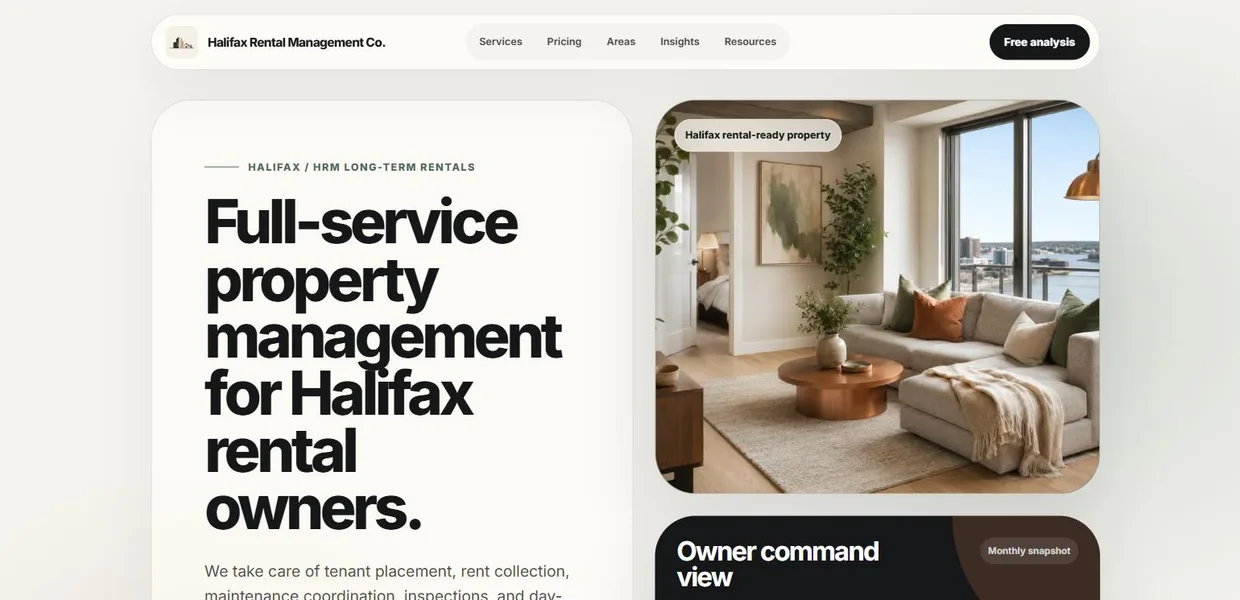
Halifax Rental Management Co. manages rental property for owners across the HRM. I built the site end to end, aimed squarely at the local map pack and the searches landlords actually run. Within about five weeks of launch it held position 4 for 'halifax property management' — and had produced a paying management contract.
First six weeks, measured
- 4.0best position on 'halifax property management'
- 43clicks in the first six weeks
- 3,244search impressions in the same period
- 1property signed under management
Real figures from halifaxrentalmanagement.com's Google Search Console, July 6 – August 15, 2026, de-duplicated by date because one export is a 20-day window overlapping two others. Two enquiries came through the site in that period; one became a signed management contract.
The brief
A local business in a category people research before they call.
Property management is a considered purchase. An owner with a rental unit does not wake up and hire a manager — they spend weeks working out what their place should rent for, whether the numbers work, what the rules are about raising rent, and how tenant screening actually operates. Only then do they look for a company.
That means two different jobs for one website. It has to win the commercial search — 'halifax property management' — where the map pack and the established firms live. And it has to be present for all the research that happens before anyone types that phrase.
The competitive research came first, before any design. The strategy that came out of it was a transparency wedge: publish the pricing everyone else hides, publish the market data everyone else gatekeeps, and let that do the persuading.
The strategy
Own the head term. Then own everything asked before it.
The site fights on two fronts at once, and the architecture reflects that split.
- 1
Money pages built for the map pack
A primary local landing page, a pricing page, a rental-analysis page, and a tenant-placement page — each complete before anything else was built. The organisation schema is RealEstateAgent/LocalBusiness with a real HRM address, service area, coordinates, and opening hours, because this site competes for the local pack rather than national organic.
- 2
Nine neighbourhood pages, not one 'areas we serve' list
Halifax, Dartmouth, Bedford, Sackville, Clayton Park, Cole Harbour, South End, North End, and Spryfield. Landlords think in neighbourhoods, and asking rents differ sharply between them — so each area page carries its own real rent data rather than boilerplate.
- 3
A research layer fed by live market data
Rent calculators, vacancy and asking-rent figures, mortgage-rate context, and eleven guides on the things owners actually ask. The market data is read live from a separate intelligence engine rather than hand-typed, so it stays current without anyone maintaining a spreadsheet.
What got built
Fifty-three routes, split by what the visitor came for.
A landlord ready to hire and a landlord still working out the numbers need different pages. They got them.
Four money pages
Property management, pricing, rental analysis, and tenant placement — the pages that exist to convert, each one complete and each one the destination of a real search.
Nine neighbourhood pages
One per HRM area, each carrying that area's own asking-rent data from a single shared source of truth rather than duplicated copy.
An insights section
A rent calculator, market news, development tracking, mortgage rates, and an opportunity view — the research tools that bring owners in long before they are ready to hire.
Eleven landlord guides
Rent increases, registration requirements, inspections, tenant screening, rent collection — written for a Nova Scotia landlord specifically, not generic advice from a US blog.
How it was built
Server-rendered, data-driven, and current without maintenance.
The same standards I hold my own site to.
Next.js App Router, TypeScript strict
Server-rendered throughout, so the local signals and the market data are all present in the initial HTML for both search engines and AI answer engines.
Live market data, read-only
Rent and vacancy figures are read directly from a separate market-intelligence database rather than copied into the codebase, so the numbers on the page are current and nobody has to remember to update them.
Server Actions for lead capture
The rental-analysis form runs on Server Actions with progressive enhancement — it works before JavaScript loads, and every enquiry is stored rather than only emailed.
Local-business structured data, done properly
Entity-linked schema with a real address, geo coordinates, service area, and opening hours — the machine-readable facts a local pack ranking is built on.
The results
The head term, the compliance cluster, and a signed contract.
'Halifax property management' — the term the whole category competes for — reached position 4.0 and has produced clicks consistently since. Alongside it the site holds page-one positions on the research cluster: 'halifax vacancy rate 2026' at 4.5, 'tenant screening' at 5.0, plus 'halifax property manager' and 'halifax property management companies' climbing behind them.
Across July 6 to August 15 the site drew 3,244 impressions and 43 clicks. Two enquiries came through the form in that window, and one of them became a signed property under management — recurring revenue, from a site that was about five weeks old.
Not everything is solved. A large share of the traffic is renters reading the rent-data pages rather than the owners the business needs, and the commercial pages are still a small slice of total impressions. That is the next problem to work, and knowing it precisely is only possible because the measurement was built in from the start.
Complete Mon–Sun calendar weeks from halifaxrentalmanagement.com's Search Console; part-weeks are omitted. Impressions keep climbing while clicks flatten — that gap is the renter-vs-owner audience problem described above.
Client review
What Halifax Rental Management said.
“Lightly Coded did an excellent job building Halifax Rental Management and creating the content for the site. I’ve been especially impressed with the quality of the articles and how well they speak to the questions and concerns Halifax property owners actually have.
“The site had only been live for about six weeks when it brought in our first client, which was incredibly exciting to see. It’s great having a website that not only looks professional, but is already starting to produce real business results.”
The takeaway
Publish what your competitors hide.
Every property manager in Halifax gates their pricing behind a phone call, and treats market data as something you get after you sign. Publishing both was the entire wedge — it earned the rankings, and it did the persuading before anyone picked up the phone.
It works because it is genuinely useful to someone who has not decided yet. A rent calculator that gives a real answer builds more trust than any page of adjectives about service quality.
The transferable part is not property management. It is this: find the thing your industry is coy about, be the one who answers it plainly, and the search traffic and the trust arrive together.
Your turn
Want one of these for your business?
Same build, same engineering — service-area structure, calculators, and content aimed at what local customers actually search. Tell us what you need the site to bring in and you'll get a straight answer on what it would take and what it would cost.