
Case study · Built by Lightly Coded
Five leads in a week, off 327 queries sitting on page one.
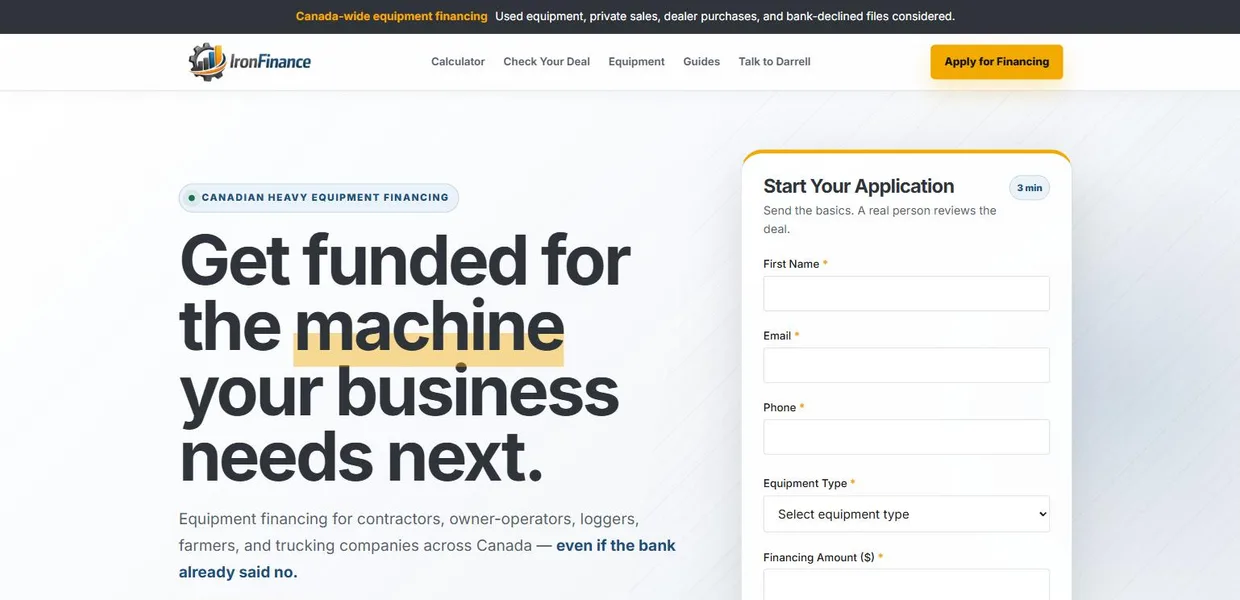
IronFinance.ca is a heavy-equipment financing site for the Canadian market — architected, built, and run end to end by Lightly Coded. In the last full week of August 2026 it drew 9,183 search impressions across 791 distinct queries, 327 of them on page one, and produced five leads. It's the clearest proof of the approach I bring to every project: pick a tight niche, answer the exact questions buyers type, and engineer the pages so search engines can read every word.
Where it stands now
- 5leads in a single week, all originating from the site
- 9,183search impressions in that same week
- 327of its queries sitting on page one
- 49clicks in that week
Two sources. Search figures come straight from IronFinance.ca's Google Search Console API for August 22–28, 2026: 9,183 impressions, 49 clicks, 791 distinct named queries, 327 of them on page one. The five leads are from the site's own enquiry records over the same stretch — four arrived through the application and contact forms, and one was an equipment dealer who phoned after finding the site, so all five originated here even though they didn't all arrive the same way. Lead counts only: no names, no deal details. Figures refreshed 2026-08-31 — the page previously carried the week ending August 15 (9,224 impressions, 881 queries, 360 on page one, 46 clicks). Week to week it is roughly flat: clicks up, impressions and query count marginally down. I report the newest measured week rather than keeping the best one.
The brief
One subject, understood completely by Google.
IronFinance is about one thing: financing heavy equipment in Canada. Excavators, skid steers, dozers, logging trucks — for the contractors and operators who need the machine now and need the funding to get it.
That tight focus is a deliberate SEO decision, not a limitation. When every page on a site reinforces the same subject, Google builds a clear, confident picture of what the site is an authority on. A site that says one thing in a hundred ways gets found faster than a site that says a hundred things once.
The strategy
Build pages for searches people actually type.
The core move is simple to describe and hard to do well: stop writing pages that describe a service, and start writing pages that answer a specific question a buyer is searching right now.
- 1
Target the exact query, not the category
Not "equipment financing" in the abstract — "logging equipment financing for bad credit in BC," "average price of a used excavator in Canada," "can you finance a 2012 Cat 320." Each is a real search with a real person behind it who is close to a decision.
- 2
Catch the buyer at the moment of intent
Someone searching those terms has a machine picked out, a seller waiting, maybe a bank decline behind them. They're not browsing — they need an answer and a next step. Pages built for that moment convert far better than pages built for a keyword.
- 3
Win a narrow battlefield first
Equipment financing is competitive, but it's a defined niche. Ranking there is achievable in a way that ranking for "web design" or "SEO" — broad markets crowded with older, heavier domains — simply is not for a young site. Pick a fight you can win, then widen.
How it's built
A content system, not a brochure.
Impressions don't come from one clever page. They come from many specific pages, each earning its own searches, all pointing at the pages that convert.
A library of buyer-question guides
Around 35 in-depth guides, each aimed at one specific query — pricing, hours, credit, down payments, lease-vs-finance, what happens on default. Every guide leads with a direct answer in the first sentence, the way an answer engine wants to read it.
A province matrix that multiplies reach
"Logging equipment financing for bad credit" isn't one page — it's a set: Alberta, BC, Saskatchewan, Manitoba, and a national version. Each ranks on page one for its own province, and together they pull hundreds of impressions a week the broad version never would have.
Tools that earn links and trust
A payment calculator, an equipment-value estimator, a financeability checker. Interactive, genuinely useful, and the kind of thing other sites reference — which is its own ranking signal.
Money pages the content funnels into
Every guide exists to move a reader toward the pages that matter: the application, the lenders overview, the "declined by your bank?" path. Content earns the visit; the conversion pages do the work.
The engineering
The structure is what makes the content findable.
Good content on a badly-built site doesn't rank. The same engineering standards behind every Lightly Coded project are what let IronFinance's content get read in the first place.
Server-rendered, every word
Pages arrive as complete HTML. Search engines and AI answer engines see the full content with no JavaScript to execute — nothing important is hidden behind a script that a crawler might skip.
Schema on every page
Structured data tells Google precisely what each page is — an article, an FAQ, an organization — so it can lift clean answers straight into search and answer-engine results.
Fast on a real phone
Lean code and properly-sized images mean the pages load quickly on the mid-range phone and imperfect connection a contractor actually uses in the field. Speed is a ranking factor and a trust signal at once.
Answer-first formatting
Direct answer up top, clear headings, real questions answered plainly. It reads well for a person skimming and extracts cleanly for an AI summarizing — the same structure serves both.
What happened
A young site, already getting found.
IronFinance went from first indexing in early 2026 to surfacing for 881 distinct queries in a single week, drawing 9,224 impressions and 46 clicks — and 360 of those queries now sit on page one. For a domain barely six months old in a competitive niche, that is the long-tail guides doing the heavy lifting: pages like "logging equipment financing for bad credit in BC" rank for exactly the searches they were written for.
The shape of it is the point. Ten weeks earlier the same site drew ~3,700 impressions across 430+ queries; it has roughly two-and-a-half times that now, and weekly clicks have gone from the mid-teens to the high forties. That's the normal curve for this approach — a niche site earns its specific, high-intent pages onto page one first, then the broader, higher-competition terms follow as the domain builds trust.
None of this is paid traffic, a viral moment, or a trick. It's the compounding result of many specific pages, each engineered to be found and to answer the question behind the search.
The last twelve complete Mon–Sun calendar weeks from IronFinance.ca's Search Console. These are not the same seven days as the week quoted above, so the last point — 9,598, the week of August 10 — is a different week from the 9,224 of August 9–15. The wider gap in late June is missing export data, not a quiet period: points are placed by real date rather than evenly spaced.
What this means for your business
The same playbook works for a contractor or a local service business.
If your customers search before they hire — and they do — the IronFinance approach maps directly onto your business. Trade your one broad "services" page for a set of specific pages that answer the exact things your customers search: the problem they have, the question they ask, the town they're in.
That's the work Lightly Coded does: the search-ready structure, the pages that target real queries, the local-visibility groundwork, and the lead path that turns a found page into a phone call. The free audit is the fastest way to see where your site stands today.
Your turn
Want a site built to get found like this one?
Architected, built and shipped end to end by the person you'd be talking to. Tell us what the site has to do and you'll get a straight answer on what it would take and what it would cost.